Reflections on Visiting Qianhai: Innovation, Openness, and Opportunity
An HKWYSC excursion into Shenzhen’s innovation ecosystem.
 Qianhai and Shenzhen as a forward-looking urban and innovation landscape.
As part of the HKWYSC programme, I had the opportunity to join a small-group excursion to Shenzhen’s Qianhai district. Although our group was modest in size, it was remarkable in composition: among us were, quite exceptionally, a Nobel Laureate and a Turing Award Winner. This made the visit feel both intellectually special and personally memorable. It also created a setting in which the conversations, observations, and impressions of the day carried particular weight.
The excursion took us across several companies operating in Qianhai and the broader Shenzhen innovation ecosystem. We visited businesses active in areas such as smart home devices, robotics, medical devices, and memory or storage technologies. Unfortunately, I no longer recall the specific company names or all of the individuals we met. What remains much more clearly is the overall impression: Qianhai presented itself as a place of ambition, openness, and opportunity.
What remained with me most was the impression of Qianhai as a place of opportunity — open, forward-looking, and eager to engage international business.
Each company visit offered a different window into Shenzhen’s innovation landscape. The smart home device manufacturer illustrated how consumer technologies are becoming increasingly integrated, connected, and responsive to everyday needs. The robotics company reflected Shenzhen’s strength in hardware, automation, and applied engineering. The medical device company demonstrated how technological innovation can move quickly into sectors with direct social and human impact. The memory and storage company, meanwhile, was a reminder that beneath the visible layer of digital transformation lies a deep technical infrastructure, without which modern computing, data processing, and artificial intelligence would not be possible.
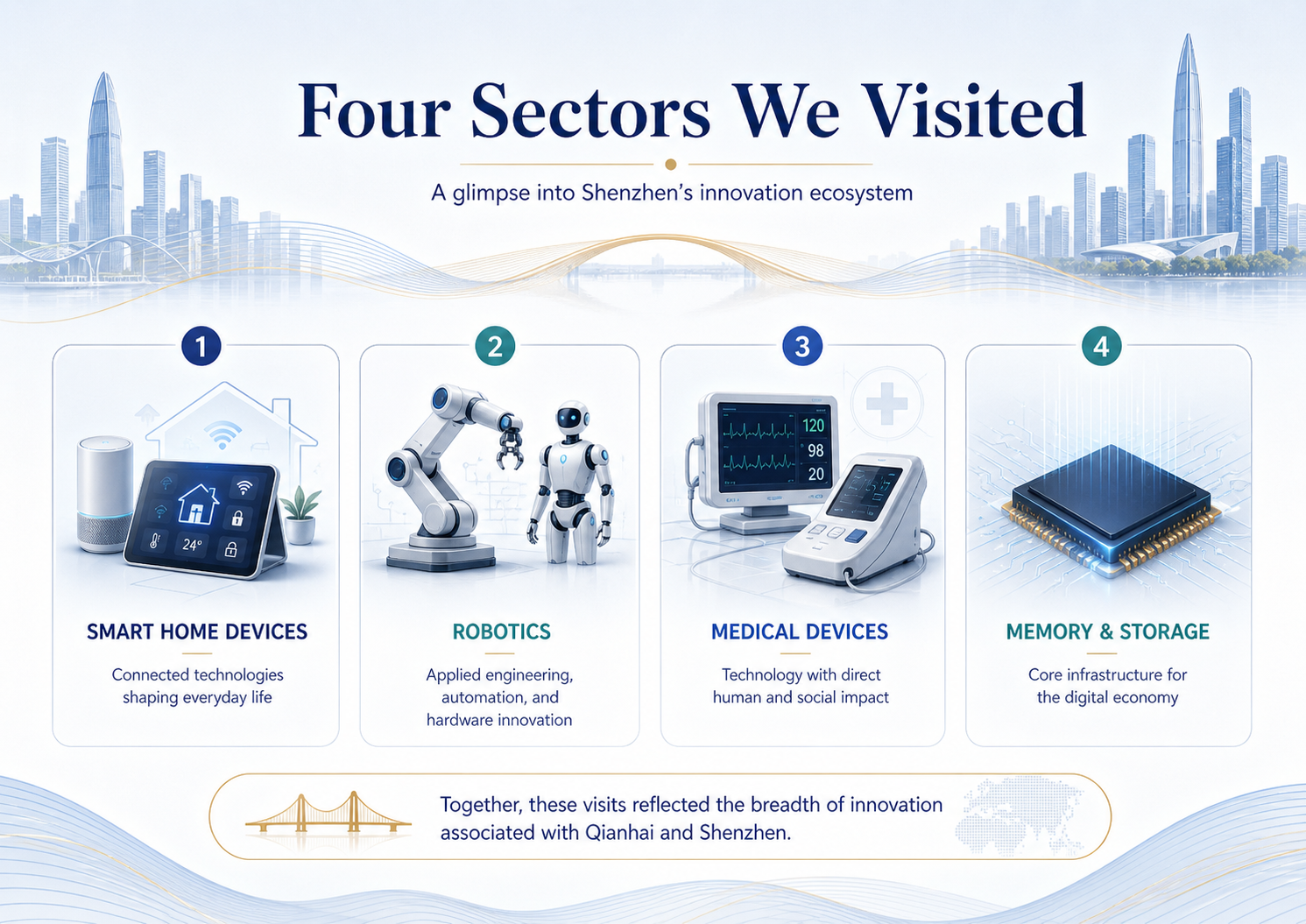 The excursion offered a compact glimpse into several areas of Shenzhen’s innovation ecosystem, from robotics to medical devices and digital infrastructure.
What struck me most was not any single product or technical demonstration, but the density of activity. The companies we visited seemed to share a strong orientation toward application, commercialization, and scale. There was a clear sense that innovation was not treated as something abstract or distant, but as something to be built, tested, manufactured, financed, and brought to market. This practical energy is perhaps one of Shenzhen’s defining characteristics, and Qianhai appears to channel it in a particularly international direction.
A further highlight was the lunch with a district leader. While I do not remember every detail of the conversation, I remember the message very clearly: Qianhai wants to be seen as a place where international people and international businesses can engage with China’s innovation economy. The district was presented not only as a local development zone, but as a bridge — between Shenzhen and Hong Kong, between mainland China and the global economy, and between technological capability and commercial opportunity.
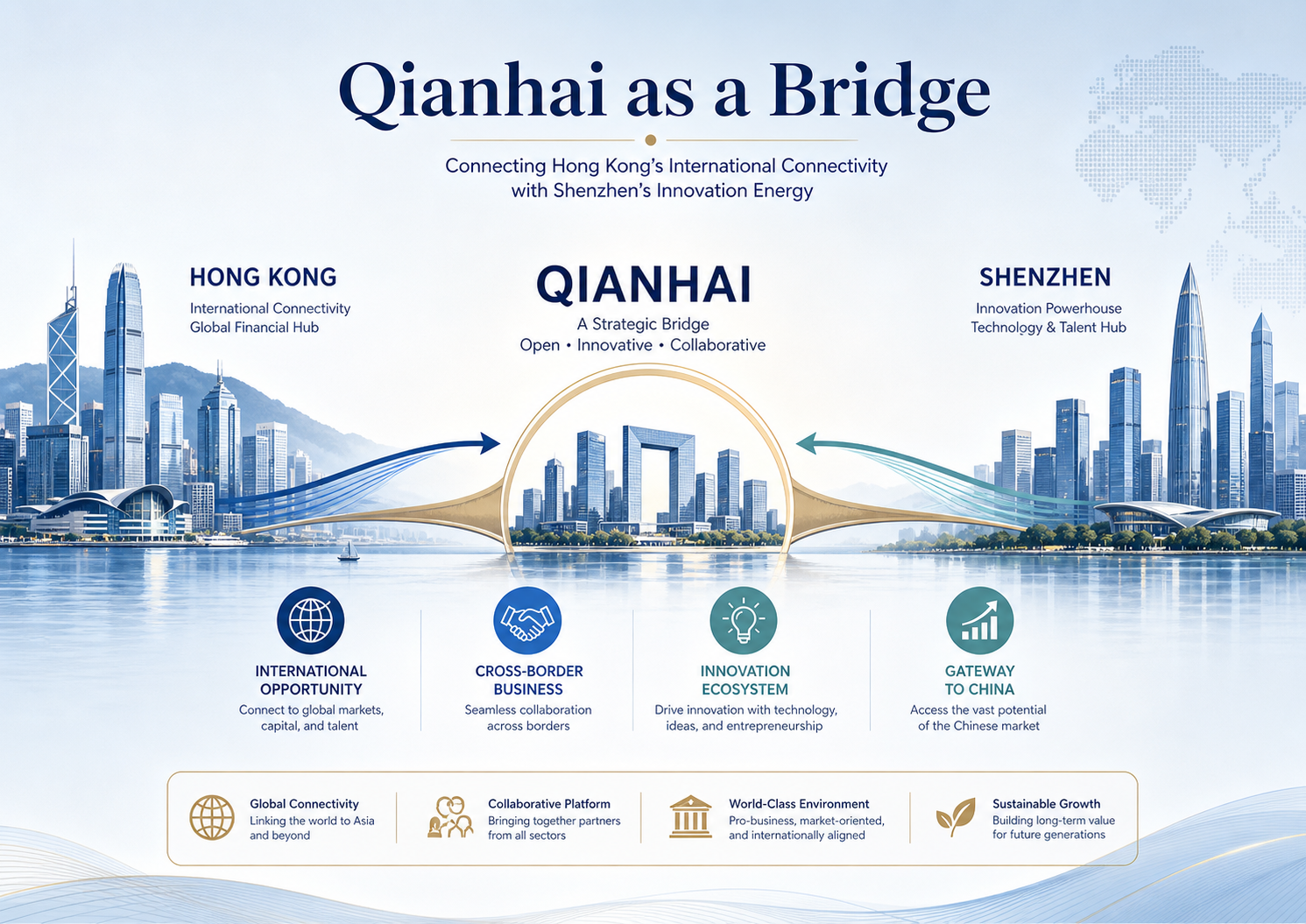 Qianhai’s strategic role lies in connecting Hong Kong’s international orientation with Shenzhen’s innovation energy.
This message resonated with me. Coming from outside China, it is easy to view the Chinese innovation ecosystem as impressive but difficult to access. Qianhai seemed designed to challenge that assumption. The emphasis was on accessibility, partnership, and openness to global business. The visit conveyed that Qianhai is not merely a place where Chinese companies grow, but also a place where international actors may find ways to participate, collaborate, and build.
At the same time, the excursion made me reflect on the role of geography and policy in shaping innovation. Qianhai’s proximity to Hong Kong is clearly not incidental. It gives the district a distinctive position: close to Shenzhen’s manufacturing and technology base, while also oriented toward international finance, trade, professional services, and global connectivity. In that sense, Qianhai appears to occupy a strategic middle ground. It benefits from the dynamism of Shenzhen while drawing on the international orientation historically associated with Hong Kong.
For me personally, the visit left a strongly positive impression. It was not simply a tour of companies; it was a carefully curated encounter with a development model. The organizers and hosts seemed to want us to understand Qianhai as a place of possibility — a district built to attract talent, capital, technology, and business from across borders. Whether one is an entrepreneur, researcher, investor, or policymaker, the implicit invitation was clear: Qianhai is open for engagement.
Looking back, I may not remember every company name or every presentation slide, but I do remember the atmosphere: confident, forward-looking, and pragmatic. The excursion offered a glimpse into how Shenzhen continues to position itself as a powerhouse of innovation, and how Qianhai seeks to make that powerhouse more accessible to the world.
In this sense, the visit was one of the most valuable parts of the HKWYSC experience. It connected high-level discussions about science, technology, and global cooperation with the concrete reality of companies, products, infrastructure, and local leadership. It reminded me that innovation does not happen only in universities, laboratories, or conferences. It also happens in districts, supply chains, factories, policy zones, and conversations over lunch.
My main takeaway from Qianhai is therefore simple: it is a place that wants to be understood as a gateway. A gateway into Shenzhen’s innovation ecosystem, into China’s market, and into new forms of international collaboration. For an international visitor, that message was both clear and compelling.